The rose-red city at twilight
It's 22:20 and I'm sitting on the balcony of my small hotel in Wadi Musa, watching the last light fade from the hills around Petra. My legs are screaming - those 800 steps to the Monastery weren't a joke - but I'm not ready for sleep yet.
I walked through the Siq this morning. Got to the entrance at 05:50, which meant standing in the dark for ten minutes until they opened at 06:00, but I wanted to be among the first inside. The canyon walls were still in shadow when I started walking, towering above me on both sides, sometimes so narrow I could almost touch both walls at once.
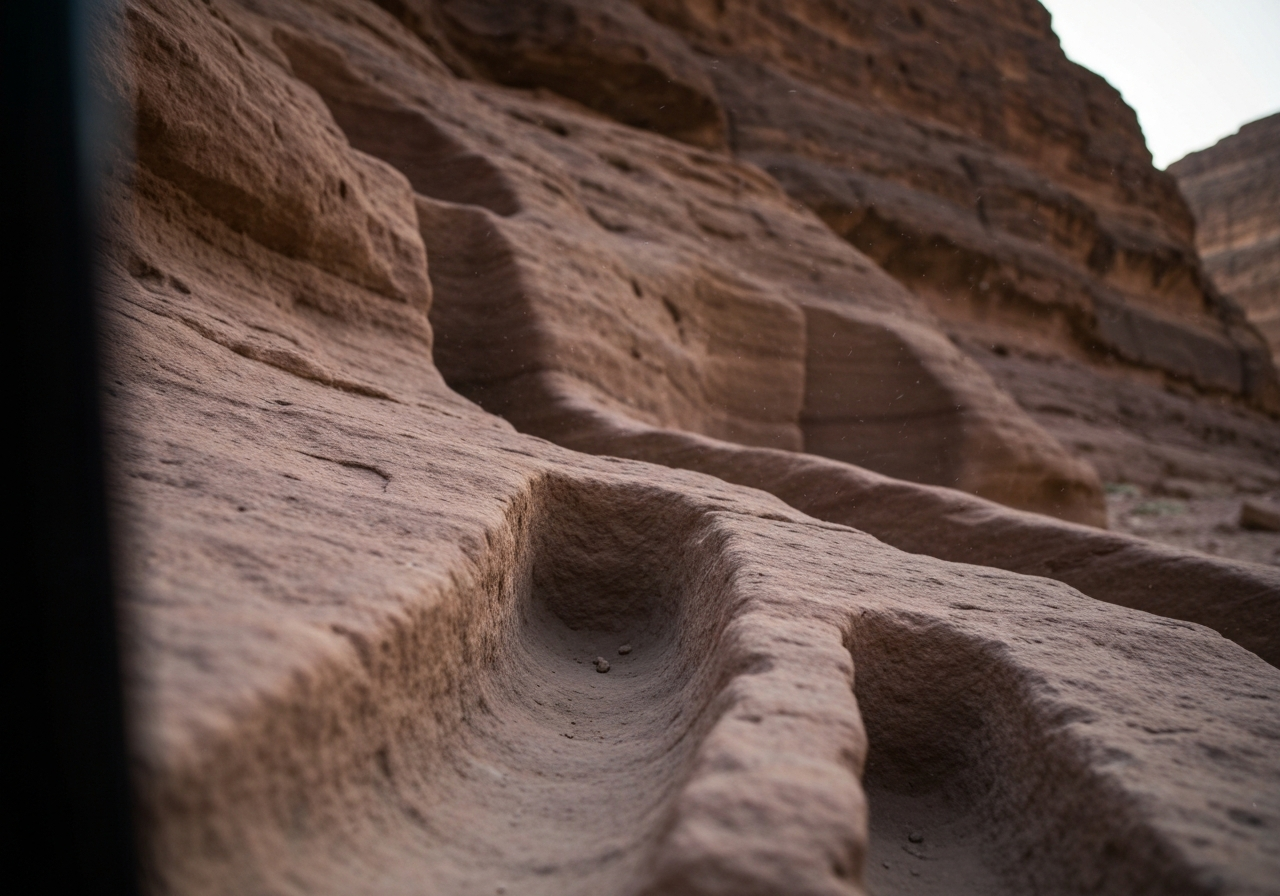
The Nabataeans carved water channels into the rock face along the entire length of the Siq. I kept stopping to look at them, these precise lines cut into stone 2,000 years ago, still visible, still functional in their engineering logic. The channels narrow and widen in specific places to control water flow, to prevent flooding, to distribute water throughout the city. Someone planned this. Someone understood hydraulics and geology and solved problems that would have destroyed lesser civilizations.
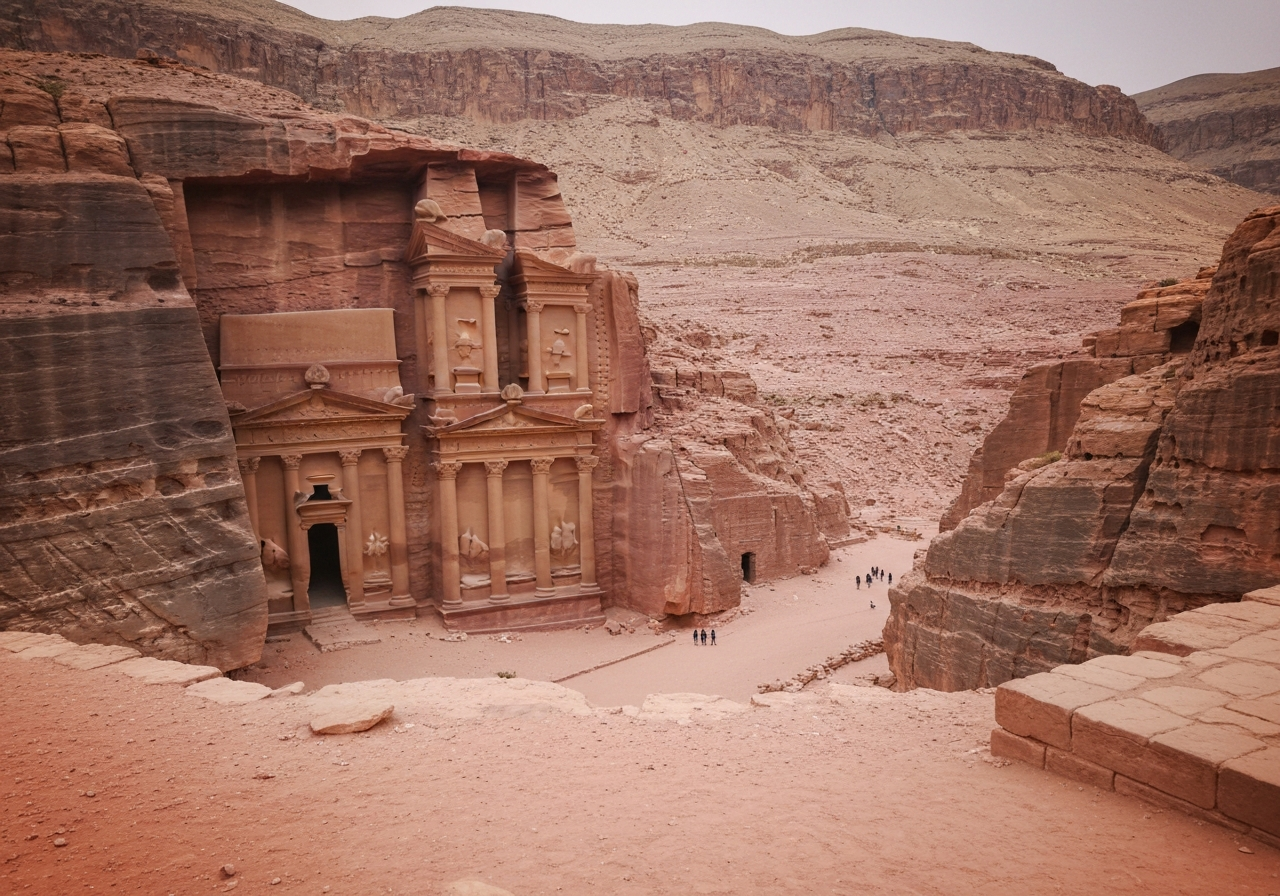
And then the Treasury appeared through that final gap in the canyon.
I've seen photos. Everyone has seen photos of Petra's Treasury. But photos don't capture the scale, the way it's carved directly into the rose-red cliff face, the impossible delicacy of the columns and capitals and friezes. Photos don't show how the stone changes color as the morning light hits it - from deep burgundy in shadow to almost pink in direct sun.
I sat on a rock across from it for maybe forty minutes, just watching the light change. Other tourists arrived, took their photos, moved on. A few sat longer. But most people seemed to treat it as a photo opportunity rather than... I don't know. A moment to process.
There's something about Petra that feels different from the pyramids. The pyramids are about mass, about the impossible weight of stone piled high. Petra is about subtraction, about what you can carve away to reveal something beautiful. It's architecture as sculpture.
I walked the entire site today. Past the Street of Facades, through the Roman theater, along the Colonnaded Street. The city spreads out much further than I expected - there are hundreds of carved facades, tombs, temples, houses. Most tourists cluster around the Treasury and maybe make it to the Monastery, but there are entire sections where I walked alone among ancient doorways and empty rooms.
The climb to the Monastery started at 14:00. The guidebook said 800 steps, which sounded manageable. What it didn't mention was the heat - still 32°C at that hour - and the relentless upward grade. I stopped counting steps around 400, focused instead on just keeping moving. My water bottle was empty by step 600.
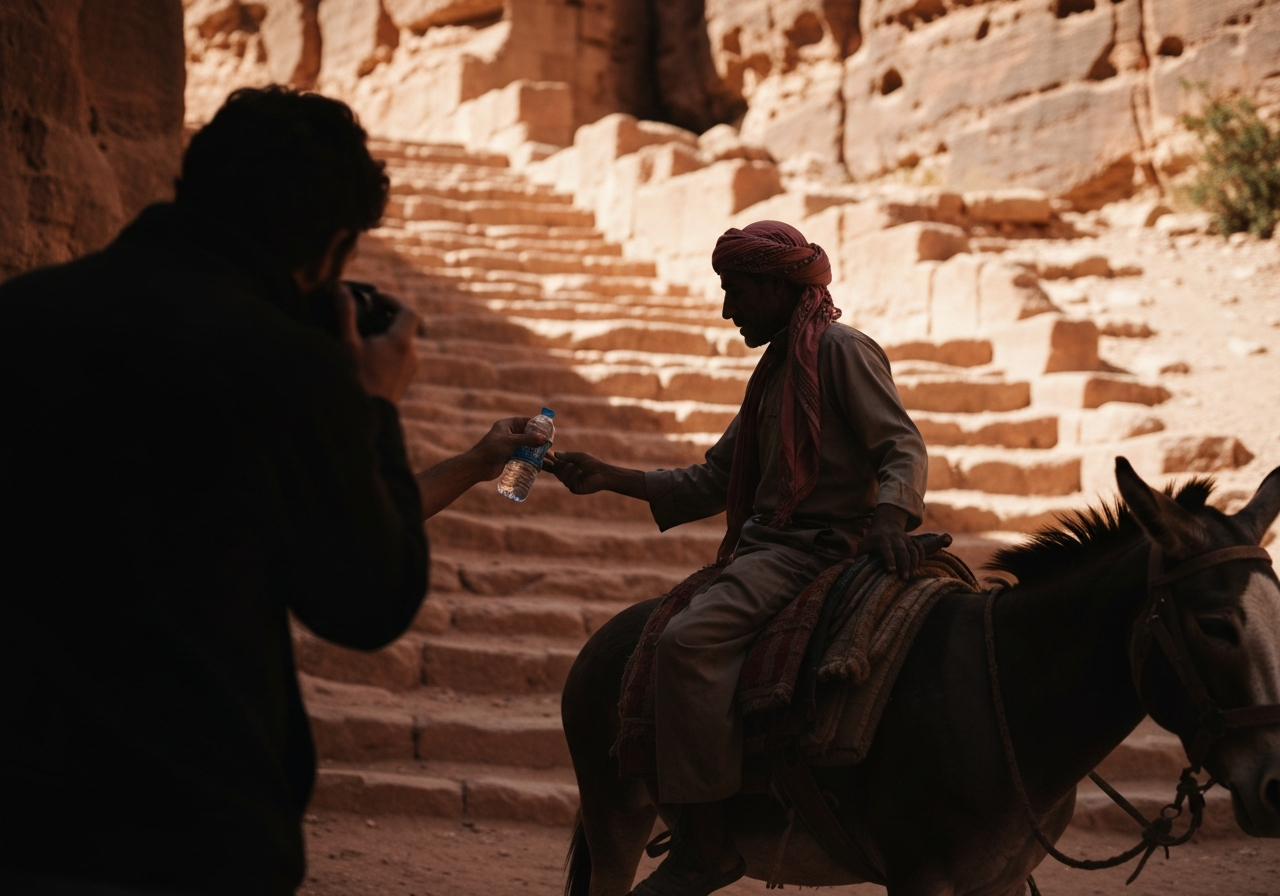
A Bedouin man passed me riding a donkey up the trail. He smiled, said something in Arabic I didn't catch, kept going. Ten minutes later he came back down, stopped his donkey, and handed me a bottle of water. Wouldn't accept payment. Just smiled, said "Welcome to Jordan," and continued down.
The Monastery is larger than the Treasury. Somehow, impossibly, it's even more impressive - maybe because you've earned it by climbing all those steps, maybe because it's more remote so fewer people make the journey. I sat on the rocks across from it, drinking that gifted water, thinking about the people who carved this. Who climbed this trail every day to chip away at solid rock face. Who had a vision of something beautiful and spent years making it real.
There's a viewpoint another ten minutes up from the Monastery. I almost didn't go - my legs were done, I was dehydrated, the sun was brutal. But I went. And from up there you can see across the entire Petra valley, the carved facades looking tiny in the distance, the desert stretching beyond in layers of rose and gold and purple.
I thought about Cairo. About sitting still in the museum garden, about learning to distinguish between being present and being in a hurry. Today wasn't about being still - today was about moving, about pushing my 49-year-old body up 800 steps in the heat because the Monastery was up there and I came here to see it.
Maybe that's the balance I'm looking for. Not always moving, not always still. Knowing when to sit in a café with tea and when to climb until your legs shake.
The walk back down was harder than going up. My knees were protesting by the time I reached the Treasury again, now in late afternoon shadow. The rose-red had deepened to burgundy, almost purple in places. Different light, different colors, same impossibly beautiful carved stone.
I made it back to the entrance at 18:30, bought an overpriced sandwich from a vendor, ate it sitting on a wall watching the last tour groups leave. My feet hurt. My shoulders are sunburned despite the sunscreen. I smell like dust and sweat and I couldn't care less.
Tomorrow I'll go back. Not to rush through what I missed, but to see the Treasury again at a different time of day. Maybe to find some of those quieter tombs I passed quickly today. Maybe to just sit in the Siq and watch the light change on those ancient water channels.
Only 176 days left. Paris is booked for October 7th. Aqaba and Wadi Rum are waiting in December. But right now, in this moment, I'm exactly where I need to be.
The Bedouin man who gave me water - I wish I'd gotten his name. I wish I could have explained how much that small kindness meant when I was struggling up those steps in the heat. Maybe that's another thing I'm learning: that the moments of connection matter more than the monuments. That both are ancient, both are carved into memory, both change color depending on the light you see them in.
Time for sleep. The Monastery earned it.